

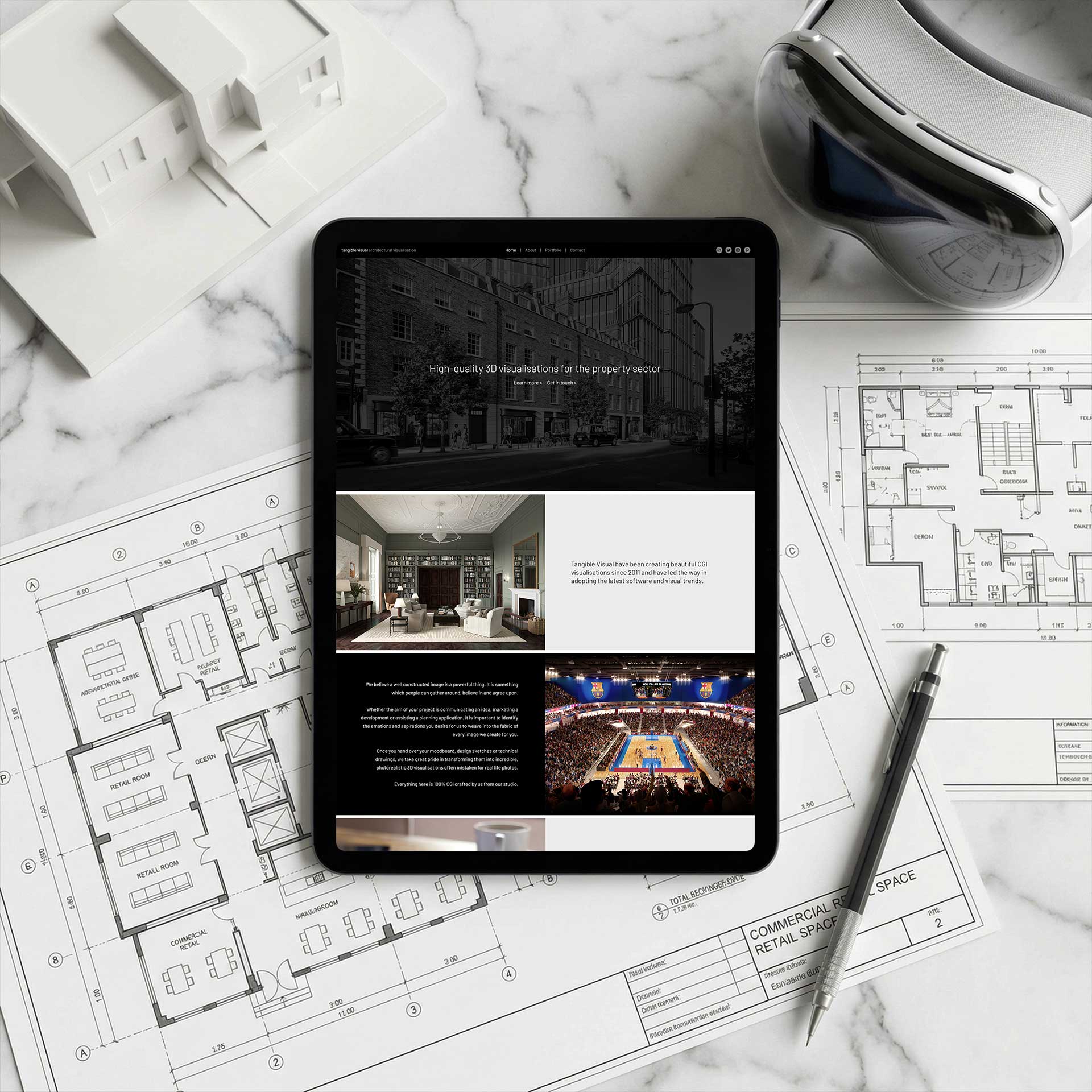
Website Design for Tangible Visual
Written by Peter Skitt, Creative Director of Buzz Design
Tangible Visual is a specialist company in architectural visualisation, product rendering, animation, and VR solutions — a business whose entire proposition rests on the quality of its visual output. When they approached Buzz Design, the brief was a design-only project: the Tangible Visual team was already proficient in WordPress and chose to build the site themselves using the design as their blueprint. This required a different kind of collaboration — design as a complete, self-contained deliverable rather than as the first stage of a build process.
Challenges
A website for an architectural visualisation company cannot be ordinary. If the site looks generic, it signals immediately that the business cannot apply its visual expertise to its own presentation — which undermines the entire proposition. The design had to perform at the same level as the work it was showcasing.
The client came with strong opinions, a clear aesthetic, and a good visual eye developed through years of high-end creative work. Collaboration required listening as much as directing, and presenting ideas as responses to a brief rather than impositions of an agency aesthetic.
Designing for client self-build means every design decision must translate cleanly into a WordPress environment without a complex handover. The design had to be buildable, not just beautiful.
Design Process
Extensive discovery conversations established the brand voice, design aesthetic, and the client experience Tangible Visual wanted to create for visitors to the site. A mood board was developed and signed off before any visual design began — an agreement on direction that prevented misaligned first drafts and the wasted time that goes with them.
The layout was developed to prioritise large-format visual assets — renders, animations, VR walkthroughs — with restrained typography and minimal structural chrome. The goal was a site that got out of its own way and let the portfolio lead.
Service descriptions were kept concise and written to complement the imagery rather than compete with it. The final design was delivered with clear documentation and layout guidance so the Tangible Visual team could build the site confidently and consistently in WordPress, without needing a development contact to interpret design intent.
Solutions
The design centred on large-scale visual assets with restrained typography and a minimal layout that gives the portfolio the space it needs to make an impression. Service and capability descriptions are clear and concise, supporting the imagery without overshadowing it.
The site structure was designed specifically for client self-management in WordPress, with a clear documentation package delivered alongside the design to enable a consistent and confident build.
Results
Tangible Visual launched with a website that matched the quality and creativity of their output — the most important outcome for a business whose credibility depends on its visual presentation. The client successfully built and launched the site from the design, demonstrating that the documentation and handover approach had worked.
The design-only model delivered a cost-effective solution that gave Tangible Visual full control over their own platform without compromising on the visual quality of the result.
Lessons Learned
Design-only projects require a particularly thorough handover. The quality of the outcome depends entirely on how clearly the design intent is communicated — not just the aesthetics, but the reasoning behind layout decisions, spacing choices, and typographic rules.
For creative sector clients, the website is part of the portfolio. It is assessed as a piece of creative work, not just as an information delivery mechanism. It has to perform at the same level as the work it showcases — or it actively undermines the case the portfolio is trying to make.
Collaborative briefing almost always produces better results than presenting cold. When a client has been involved in establishing the direction, the first design presentation is a refinement conversation rather than a reaction to something unexpected.
Start your web design project today
If you’re thinking about a new website, or you know your current one isn’t doing the job it should, let’s talk. Call us, email us, WhatsApp us, or fill in this form and we’ll get back to you shortly.